Who builds large-scale solar parks in Europe? 5 Essential Facts
Who builds large-scale solar parks in Europe? Specialized construction companies with utility-scale expertise deliver these complex infrastructure projects, managing everything from site preparation and foundation engineering to electrical installation and grid connection. These firms operate as full-service partners for developers, handling the technical execution that transforms project permits into operational power plants. The European solar construction market has matured significantly, with experienced contractors now capable of delivering projects exceeding 500 MW while meeting strict quality certifications and grid code requirements. Understanding who executes these projects – and how they differ in capability – is critical knowledge for developers, investors, and energy authorities planning renewable infrastructure investments.
Understanding Who Builds Large-Scale Solar Parks in Europe Today
The construction of utility-scale solar installations in Europe involves several distinct categories of companies. General contractors with renewable energy divisions, specialized photovoltaic construction firms, and vertically integrated developers each approach projects differently. The most reliable outcomes typically come from dedicated solar construction specialists who focus exclusively on photovoltaic infrastructure.
These specialized firms bring project-specific expertise that general contractors often lack. Foundation engineering for tracker systems, high-voltage electrical work, and commissioning protocols require teams with hundreds of megawatts of direct experience. Companies operating across multiple European markets must also navigate varying regulatory frameworks, grid connection standards, and permitting requirements in each jurisdiction.
The distinction between project development and project construction deserves emphasis. Developers secure land rights, permits, and financing. Construction partners execute the physical build. Some organizations handle both functions, though separation often produces better outcomes through focused expertise at each stage.
Key Capabilities of European Solar Park Construction Companies
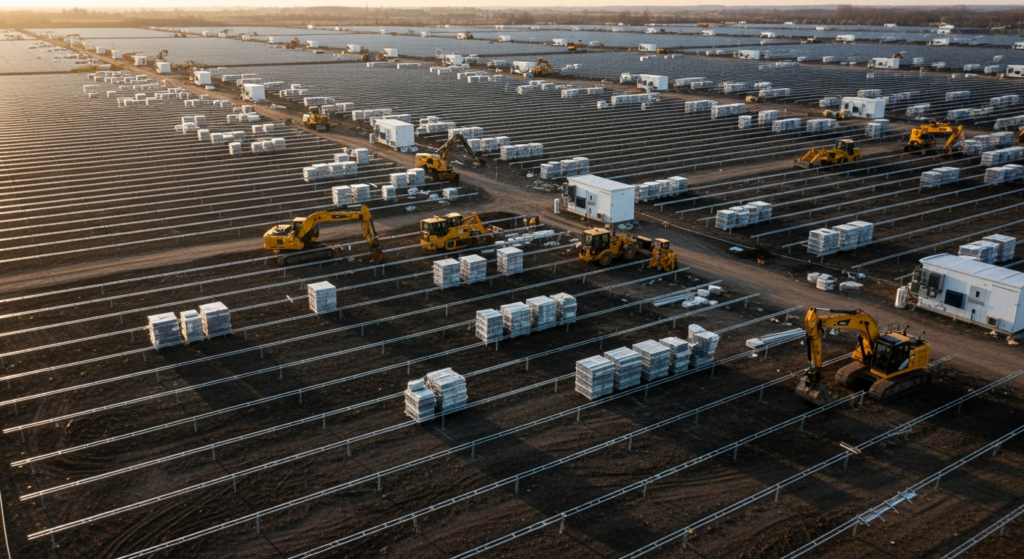
Professional solar construction firms demonstrate competence across several technical domains. Site assessment and geotechnical analysis determine foundation requirements. Civil works including access roads, drainage, and cable trenching prepare locations for installation. Mechanical teams mount racking systems and modules while electrical crews install inverters, transformers, and medium-voltage infrastructure.
Grid connection represents a critical capability that varies significantly between contractors. Experienced firms maintain relationships with transmission system operators and understand the technical requirements for connecting projects to national grids. This expertise directly impacts project timelines and commissioning success rates.
Quality certifications provide measurable indicators of contractor capability. ISO 9001 quality management, ISO 14001 environmental management, and ISO 45001 occupational health and safety standards demonstrate systematic approaches to project execution. German engineering standards remain particularly respected across European markets.
Where Large-Scale Solar Parks Get Built Across Europe
Geographic distribution of utility-scale solar development reflects both solar resource availability and regulatory support mechanisms. Spain leads European markets with favorable irradiance and streamlined permitting. Germany maintains strong development despite lower solar resources, driven by energy transition policy and premium pricing for renewable electricity.
Poland, Italy, and Portugal represent growing markets attracting significant construction activity. Eastern European nations including Romania and Greece offer attractive project economics, though grid infrastructure limitations require careful assessment. The United Kingdom continues developing despite Brexit complications, with established planning frameworks supporting large installations.
Construction companies serving multiple markets must adapt to local conditions while maintaining consistent quality standards. Weather patterns affect construction windows. Soil conditions vary dramatically between sandy Mediterranean terrain and rocky northern sites. Grid codes differ between countries, requiring equipment specification adjustments.
How Developers Select Companies That Build Solar Parks in Europe
Developer selection criteria for construction partners typically prioritize track record, financial stability, and technical capability. Reference projects of similar scale and technology demonstrate relevant experience. Balance sheet strength indicates ability to execute contracts through completion without financial distress disrupting work.
Contract structures vary between fixed-price turnkey agreements and cost-plus arrangements. Fixed-price contracts transfer execution risk to construction partners, requiring accurate estimation capabilities. Cost-plus structures suit complex sites where ground conditions or grid requirements remain uncertain during contracting.
Timeline reliability represents a crucial selection factor. Construction delays impact financing costs, power purchase agreement obligations, and subsidy qualification deadlines. Experienced contractors maintain realistic schedules and communicate proactively when challenges arise. The utility-scale solar construction guide provides additional detail on contractor evaluation criteria.